
Retail and wholesale credit decisions are made in a specific macro condition of the economy. Capital however is calibrated to a long-run average. Today, these two views live in separate Probability of Default (PD) models with separate use cases. However, separate governance, separate validation cycles, additional administration are leading to frictions and additional costs when maintaining distintinct models. What if one underlying model could serve both purposes, with the model's PIT macroeconomic alignment driving credit decisions and the model's TTC view driving capital?
 At Auriscon Ltd, we propose our DtH PD model for dual use:
• For use in portfolio management, early warning and pricing, the PD model runs on the current macro state; delivering a genuine point-in-time (PIT) PD that reflects today’s macroeconomic impact on credit drivers.
• For use in regulatory capital calculation, the same model is transformed to a through-the-cycle (TTC) output delivering a long-run average PD view.
The Dual-Use DtH PD architecture is displayed below for illustration. The model architecture includes the Point-In-Time to Through-The-Cycle conversion of PD to permit capital calculations based on the long-run-average Probability of Default.A Discrete-time-Hazard (DtH) model is used to compute the Point-In-Time (PIT) PD, allowing to accommodate time varying-information for updating account behaviour and macroeconomic conditions.
The Features of the DtH Dual-Use PD Architecture

-
The PIT PD usefulness in Pricing & Portfolio Management: The model PD at application date is sensitive to macroeconomic conditions prevailing at that time.The PIT PD for a 1-year Probability of Default is used in application scoring. This is obtained at time period t=0 by compounding the monthly hazards over 12 monthly periods ahead. The macro state \(z_0\) at time t=0 is known, and the PIT PD is a function of the macro variables relevant for the loan product and representative of the sector.
-
The DtH model's sensitivity to the Economy: The Discrete-time-Hazard (DtH) is used to compute Point-In-Time (PIT) Probabilities of Default (PD). The model type is flexible in its use, allowing to accommodate time varying-information for updating account behaviour at reporting date and macroeconomic conditions prevailing at the time of application and reporting. The DtH model uses specifications for link (logit / cloglog) and baseline (binned / period dummies / PCH). A suitable conversion maps the PIT PD to its Through-The-Cycle (TTC) long-term-average. explicitly.
-
The TTC PD and its use for Capital: Portfolios in vulnerable sectors — particularly Commercial Real Estate and SME lending — are subject to targeted review, with granular monitoring of debt-service-coverage ratios and covenant adherence.
-
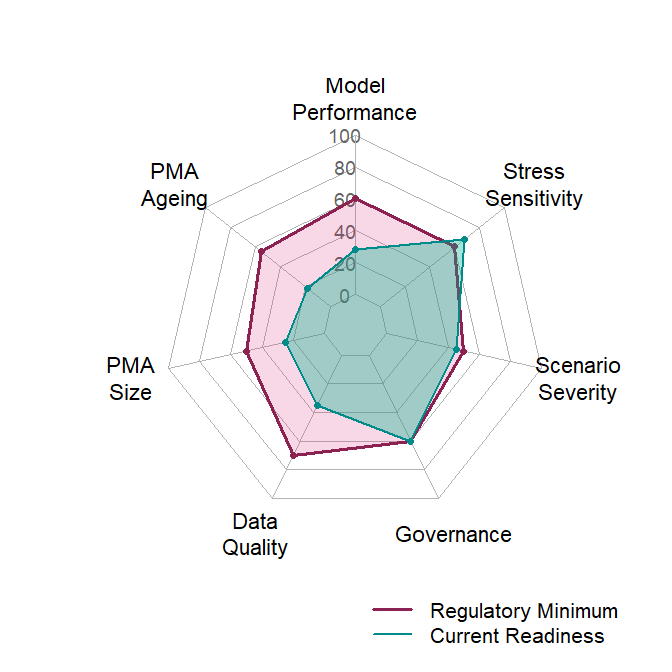
The PIT PD readily available for ICAAP: Models that smooth out macroeconomic spikes mask the non-linear effects of economic drivers on defaults. Supervisors increasingly use back-testing and transition-matrix analysis to detect smoothing. A PIT PD that fails to move under a severe scenario is itself a red flag. Out DtH PD framework is ready to respond to scenarios to inform ICAAP and other regulatory stress testing.
Demonstration of Dual-Use PD for UK Personal Loans:
Model Uses in Pricing & Porfolio Management, Capital Calculation, Stress Testing, EWS.
▶ Open dashboard in full screen
© 2026 Auriscon Ltd. No reproduction without permission. Short excerpts with attribution permitted.
Why this matters: The regulatory landscape and the dual-use-PD
Regulatory authorities are aligned to regulatory frameworks. The rating philosophy and the calibration are core principles that can be anchored in justifiable choices. A PIT rating model does not preclude LRA calibration and PIT to TTC conversion for use in capital. Basel 3.1 requirements are required to be adhered to and implemented in the UK - albeit delayed by PRA to 1 Jan 2027 (PS1/26, published 20 Jan 2026). Basel 3.1 requirements implemented in Hong Kong are set in force by HKMA since 1 Jan 2025 (B3F).
Every covariate used in a PD model must be justifiable on economic grounds, because the model is effectively making a causal claim about why default risk changes over time. For instance, unemployment rate is commonly viewed the strongest and most consistent macro driver for Personal Loans. With our DtH model a clear economic rationale about what drives default rates in the Personal Loans sector is used. The model architecture consists of a Through-The-Cycle (TTC) conversion to permit capital calculations based on the long-run-average Probability of Default (PD). The DtH model is used to compute the Point-In-Time (PIT) PD.
-
The PIT PD usefulness in Application Scoring: The model PD at application date is sensitive to macroeconomic conditions prevailing at that time.The PIT PD for a 1-year Probability of Default is used in application scoring. This is obtained at time period t=0 by compounding the monthly hazards over 12 monthly periods ahead. The macro state \(z_0\) at time t=0 is known, and the PIT PD is a function of the macro variables deemed important for the loan product and economy.
-
The DtH model's sensitivity to the Economy: The Discrete-time-Hazard (DtH) is used to compute Point-In-Time (PIT) Probabilities of Default (PD). The model type is flexible in its use, allowing to accommodate time varying-information for updating account behaviour at reporting date and macroeconomic conditions prevailing at the time of application and reporting.
-
The TTC PD and its use for Capital: Portfolios in vulnerable sectors — particularly Commercial Real Estate and SME lending — are subject to targeted review, with granular monitoring of debt-service-coverage ratios and covenant adherence.
-
The PIT PD readily available for ICAAP: Models that smooth out macroeconomic spikes mask the non-linear effects of inflation, geopolitical volatility, and rapid interest-rate cycles on defaults. Supervisors increasingly use back-testing and transition-matrix analysis to detect smoothing: ECL that fails to move under a severe scenario is itself a red flag.
-
Supervisory Stress Testing Stress‑Testing the ECL is used as a tool in regulatory testing to examine the what if impact on capital. The standard IFRS-9 calculation already incorporates a range of scenarios with weights. However, the framework must be ready to respond to scenarios beyond the standard probability-weighted range.
Disclaimer: Auriscon Ltd and Auriscon HK Ltd assume no responsibility or liability for any errors or omissions in the content of this site. The information contained in this site is provided with no guarantees of completeness and accuracy. No liability is assumed for any damages that may occur for external use of information provided herein.