
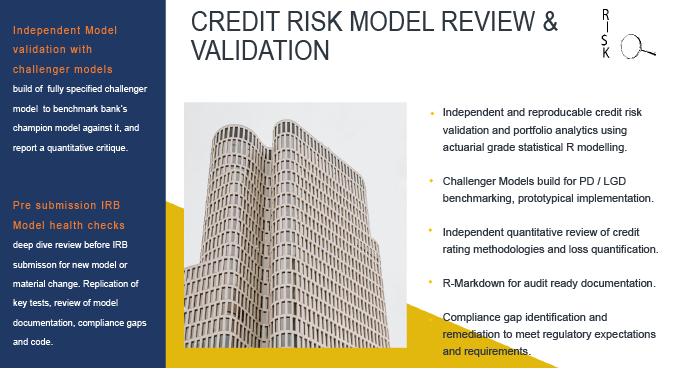
Models are subject to a regular validation cycle, with emphasis given to a thorough model backtesting and benchmarking. The validation testing typically involves review of conceptual soundness and can use information from Model monitoring (e.g. threshold breaches) to inform areas of concern. An important element of any validation is the benchmarking to a suitable challenger Model. In addition, external data and seminal papers can provide extra insight when validating Model adequacy. Auriscon specializes in the validation of Credit Risk Models based on challenger Models and indpendent replication of Model functionality.
Credit Models used for IRB Basel and IFRS 9 are often observed to deteriorate when economic condtions or business strategies undergo any significant change. A case in point is a deteriorating Model performance due to failure of addressing emerging risks in time. Consequently, both Basel IV and IFRS 9 raised the standards for Model validations. Credit Models under stress have to demonstrate robustness and to ensure that accurate calibrations are in place. After all, calibration accuracy is a pre-condition for efficient capital and IFRS9 calculations. Click the links below and read about details of Credit Validations and how Auriscon supports.
→ Case Study: LGD Validation (dashboard under construction)
→ Case Study: PD Validation (dashboard under construction)
→ Validation Testing at Data Level
Disclaimer: Data, charts and commentary displayed herein are for information purposes only and do not provide any consulting advice. No information provided in this documentation shall give rise to any liability of Auriscon Ltd or of Auriscon HK Ltd.
© 2026 Auriscon Ltd. No reproduction without permission. Short excerpts with attribution permitted.
Our Aproach
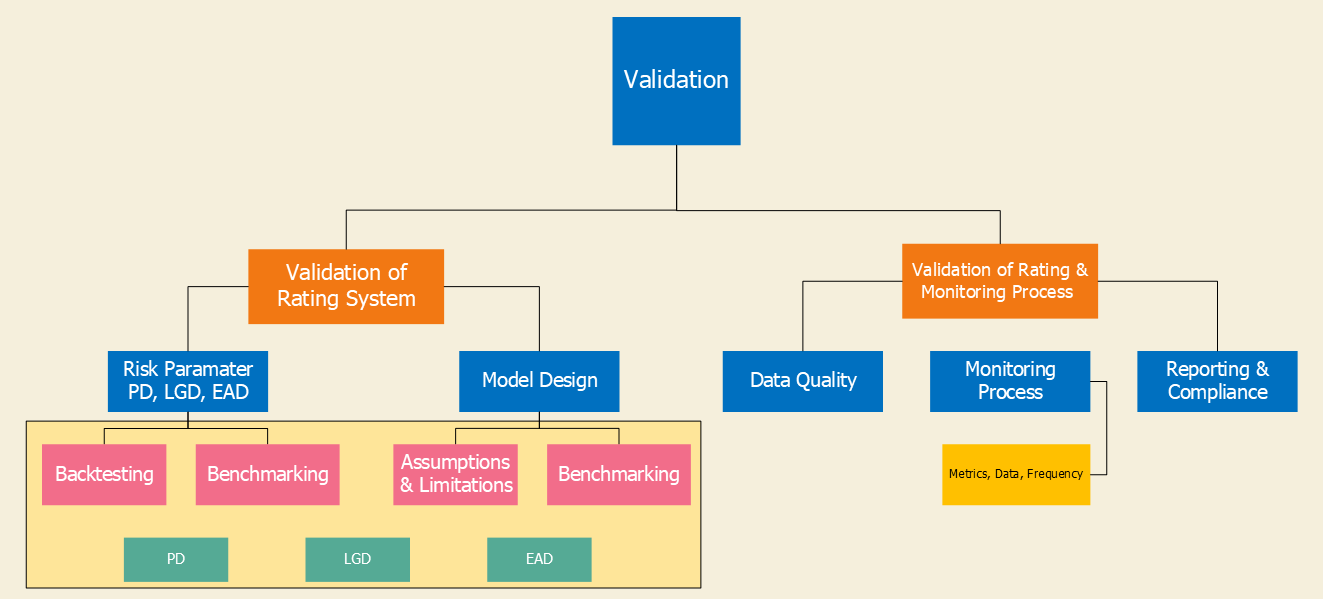
is to support or to independently perform validation of Credit Risk Models. We assist in defining and performing statistical testing and analysis covering validation of Basel and IFRS9 risk parameter PD, LGD, EAD, Risk and Economic Capital Models, and effectiveness of monitoring metrics.
Risk-Based Approach to Validation Testing
Identifying latent and emerging Risks is a key aspect every validation should aim to capture. With our support, additional view points on prevailing credit and economic positions are added. With a thorough statistical testing applied, and suitably underpinned by benchmarking and backtesting, information is gathered amd critical information about Model performance and Model risk is made transparent.
Specialisation
As a specialist provider with expertise in Credit and Model Risk, we suport based on a tailored approach suitable for Credit Wholesale and Retail portfolios. Automating validation testing and report generation based on the R programmimg ecosystem.
Validation Levels
Validation Testing proceeds in a structued way from Data Level (L1) to Model Level (L2) to Calibration Level (L3).
Specific mtrics and testing are applied for each validation level as illustrated further below for PD and LGD Models.

- Calibration Testing
- Backtesting
- Benchmarking
- Discriminatory Power
- Portfolio Stability
- Challenger Models
Case Study LGD Validation (dashboard under construction)
Validation testing of multiple LGD Models are illustrated with a Dashboard.
Multiple tests are performed at Model (Level 2) and Calibration Level (Level 3).
Case Study PD Validation (dashboard under construction)
Validation testing of multiple PD Models are illustrated with a Dashboard.
Multiple tests are performed at Model (Level 2) and Calibration Level (Level 3).
Validation Testing at Data Level (L1)

- Data Quality, measured with DQ metrics such as Currentness of data and missing values, integrated into validation testing at Level-1.
- Integrity of data, e.g. confimration of the credibiliy of data sources.
- Consistency of data, statistical tests used in the model build process to ensure suitabiliy of data used for development, e.g. outliers, concentration and bias of data, correlation in data.
- Representativeness of data in relation to the the portfolio population at the time of model build versus the time of validation. In terms of characteristics typical metrics applied e.g. Population Stabiliy Index, t-test, histogram and percentiles.